
Armed vs. Unarmed in Executive Protection: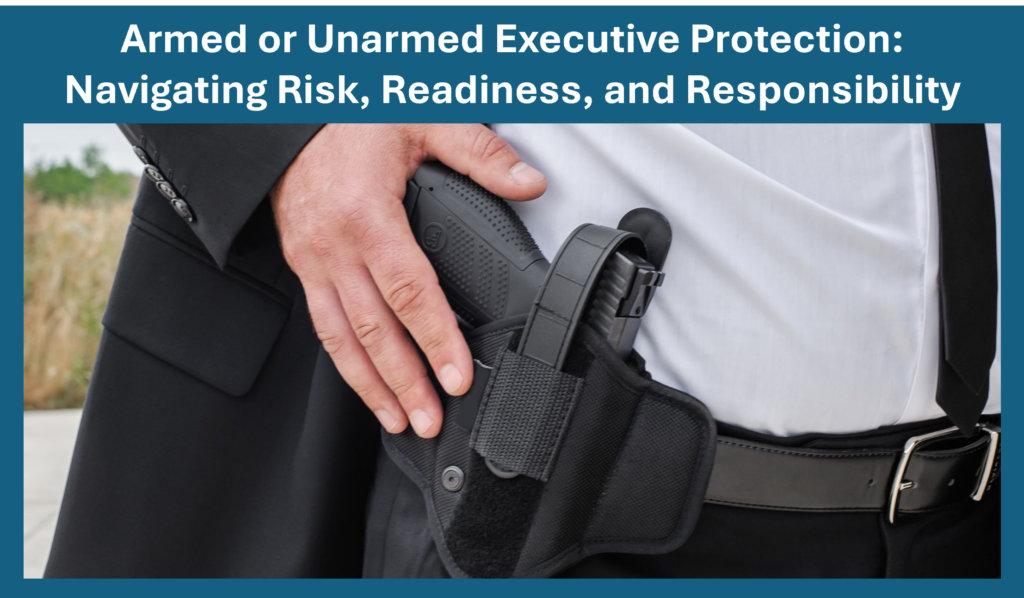

Are You Protecting the Principal – or Preparing for a Gunfight?
In the world of Executive Protection, few topics are as polarizing – or as misunderstood – as the decision to carry a firearm. For some, it’s non-negotiable: protection equals firepower. For others, especially those operating in corporate and domestic settings, being unarmed is a deliberate choice that prioritizes discretion, de-escalation, and risk mitigation.
The truth? There is no one-size-fits-all answer. But there is a non-negotiable principle: the EP specialist’s primary obligation is to cover and evacuate the principal. Not to return fire. Not to engage. Not to “take out the bad guy.”
The Mission: Cover and Evacuate
At the heart of executive protection lies a simple but uncompromising directive: preserve the life and safety of the principal. In a threat scenario, the EP specialist’s job is not to eliminate the attacker, detain a suspect, or return fire. The mission is survivability.
That means:
- Getting the principal out of the danger zone as quickly and decisively as possible
- Using your own body as a shield if necessary
- Executing a practiced, pre-planned evacuation strategy – not improvising with a weapon drawn under stress
This principle is not a suggestion. It is doctrine.
Time Budgets in Close-In Protection: Movement Over Firepower
In close protection, time is always working against you. Most attacks on principals occur at short distances and unfold in less than two seconds. That’s your total budget – for recognition, reaction, and protective movement.
In that moment, you don’t have time to:
- Assess the weapon
- Confirm intent
- Draw, aim, and engage
You have time to do one thing well: move.
And that’s exactly where trained executive protection specialists shine. Within that narrow time window, a professional can:
- Break the line of sight between attacker and principal
- Place their body between the threat and the protectee
- Initiate protective movement toward a secure location
- Delay the threat long enough for a secondary team to respond
This is not theory. It’s what decades of operational experience and after-action reviews confirm: decisive movement and physical positioning save lives.
Why Firearms Aren’t the Fastest Tool
Drawing a firearm under stress, especially in crowded or dynamic environments, introduces friction:
- Garment clearance delays draw time
- Environmental obstacles interrupt movement
- Bystander presence increases liability
- Split-second shoot/no-shoot decisions compound hesitation
Meanwhile, protective movement, redirection, and shielding require no draw time – and no lethal force. They’re faster, less prone to error, and more aligned with the mission of executive protection: preserve life, avoid escalation, and protect the principal at all costs.
A Simple Truth
In the time it takes to draw, you could already be moving.
And in most real-world EP scenarios, that movement is the difference between a successful intervention and a catastrophic failure.
Firearms Training: The Dangerous Illusion of Readiness
One of the most underexamined risks in executive protection is the false sense of security that comes with carrying a firearm. Too often, EP personnel qualify to carry based on the minimum legal requirements – not the operational standards required to use that weapon responsibly, effectively, or safely in the real world.
An annual or semi-annual qualification at a static range is not preparation for a dynamic threat. Standing on a flat surface, shooting at a paper silhouette under no time pressure, with no bystanders, no environmental chaos, and no principal to protect is not training – it’s box-checking.
What Real Readiness Looks Like
To responsibly carry a firearm in a close protection setting, an operator must regularly engage in:
- Scenario-Based Shoot/No-Shoot Training: Stress inoculation is critical. Can the agent correctly assess a situation and make a legal, ethical, and tactically sound decision to engage – under stress, fatigue, time pressure, and ambiguity?
- Force-on-Force Drills Using UTM or Simunition: These high-fidelity simulations introduce real-time feedback, consequences, and the physical chaos of a real encounter. Drawing, moving, covering, and firing in compressed environments requires muscle memory that only comes from frequent reps under pressure.
- Judgment and Discretion Training in Public Environments: Threats rarely occur in sterile spaces. Agents must be able to account for crowds, vehicles, children, media, and the principal’s loved ones. One misstep – one misfire – can trigger legal, reputational, and human consequences far beyond the intended threat.
- Frequent Requalification to EP-Specific Standards: Law enforcement or state standards are not enough. EP teams need proprietary benchmarks tailored to their operational environments and client profiles. This includes movement shooting, retention, malfunction clearing, and decision-making under duress.
The Cost of Inadequate Training
Without this level of commitment, the firearm is not a tool – it’s a liability. It can:
- Provide false confidence that slows or overrides better protective instincts
- Lead to hesitation, misjudgment, or delayed action under stress
- Increase the risk of accidental discharge, mistaken identity engagements, or missed shots in tight spaces
- Create legal exposure for the principal and company, especially if lethal force is used without adequate documentation of training and readiness
The Bottom Line
Possession of a firearm does not equal proficiency. And proficiency is not just about marksmanship – it’s about judgment, restraint, and the ability to integrate that tool into a broader protective strategy.
When EP professionals carry without the training to match, they’re not just taking on the burden of force – they’re putting the very people they’re paid to protect at greater risk.
Insurance, Legal Exposure, and Subcontractor Risk
The decision to arm an executive protection team is never just a tactical one – it is also a legal and financial commitment that carries profound second- and third-order consequences. In today’s environment of increased litigation, corporate liability scrutiny, and reputational risk, introducing firearms into an EP assignment should be approached with the same level of caution and documentation as any other high-risk operational decision.
The Insurance Premium Is Just the Beginning
Carrying firearms on an executive protection detail substantially increases the cost – and complexity – of professional liability and general liability insurance:
- Most carriers require specialized endorsements for armed assignments, often with higher premiums, lower coverage caps, and more exclusions.
- Some underwriters may refuse to cover armed subcontractors altogether without clear documentation of training, licensing, and incident protocols.
- In jurisdictions with restrictive firearm laws, non-compliance can void coverage entirely – putting both the firm and the client at serious risk.
And even with appropriate insurance, coverage doesn’t prevent litigation. It merely helps manage the financial fallout after an incident.
Use of Force = Legal, Civil, and Reputational Consequences
Even a justified use of force – one that prevents injury or loss of life – can trigger:
- Internal investigations
- Criminal inquiries
- Civil lawsuits
- Negative media coverage
- Damage to the client’s brand or shareholder confidence
For public companies and high-visibility principals, these ripple effects can quickly escalate. Protection professionals must remember: the legal standard for using force is not whether you believed it was justified – it’s whether others, after the fact, believe it was reasonable.
The Subcontractor Blind Spot
When using armed subcontractors, especially in a blended or vendor-supplied model, the risks multiply:
- Are all personnel trained to the same standards?
- Is there a consistent use-of-force policy?
- Have they undergone the same psychological screening, background checks, and qualification protocols?
- Is there a clear chain of liability if something goes wrong?
If these answers are unclear, the risk is not just operational – it’s legal. When an armed subcontractor acts under your brand or as part of your team, the client will hold you accountable, regardless of whose badge or logo is on the shirt.
A Trigger Pull Is a Lawsuit Waiting to Happen
Every time a weapon is drawn – much less fired – it opens the door to civil, criminal, and reputational exposure. Even in cases where no shots are fired, the mere presence of a firearm in a heated situation can escalate tensions, draw public scrutiny, or trigger internal review.
Clients and EP leaders alike must understand: choosing to arm your team is choosing to absorb a vastly higher level of legal and financial risk. It may be the right call in some scenarios – but it must never be made lightly, automatically, or without a fully developed risk mitigation framework in place.
Context Matters: Know Your Environment
The question of whether to arm an executive protection team cannot be answered in a vacuum. It must be informed by context. The right decision in one setting could be the wrong one in another – and in executive protection, misalignment can carry operational, legal, and reputational consequences.
There are absolutely environments where a firearm is not only justified but essential:
- High-risk principals with active threats, public controversy, or adversarial exposure
- Assignments in unstable regions, where the threat of armed violence, kidnapping, or political unrest is credible
- Government-related or politically sensitive assignments with increased exposure to ideologically motivated actors
- Situations where advanced threat intelligence indicates potential for targeted aggression or armed confrontation
In these cases, a protective posture that includes firearms – paired with rigorous training, vetted protocols, and operational discipline – is often appropriate, if not mandatory.
But Context Cuts Both Ways
In many domestic corporate settings, however, an armed posture can introduce more risk than it mitigates. Consider the typical environments in which executive protection teams operate:
- Corporate headquarters
- Luxury hotels
- Airports, campuses, or office parks
- Client meetings, media appearances, or public-facing events
- Family gatherings or charitable functions
These are environments where the presence of a visible weapon may:
- Cause discomfort or draw unwanted attention
- Violate local laws or venue policies
- Create unnecessary tension with staff, vendors, or guests
- Increase liability in the event of a conflict or confrontation
Here, the most effective protection comes not from a firearm – but from:
- Advance planning
- Site familiarization and evacuation routes
- Surveillance detection
- Strategic positioning
- De-escalation skills and rapid decision-making
An unarmed EP specialist who is confident, observant, and tactically prepared often provides a higher level of protection in these environments – precisely because they are aligned with the setting, the threat level, and the principal’s lifestyle or brand.
Aligning Threat, Environment, and Presence
The best protection programs don’t make blanket decisions about firearms. Instead, they ask:
- What is the actual threat landscape?
- What are the client’s preferences and exposures?
- What is the operational setting, and how will an armed presence be perceived?
- Can the same goals be achieved – more safely, discreetly, or effectively – without a weapon?
In many cases, the answer will vary from day to day, trip to trip, or venue to venue. And that’s the point: executive protection is contextual. When it isn’t, it becomes predictable – and predictability, in protection, is a vulnerability.
We Are Not Law Enforcement
One of the most important lines to draw in executive protection is the one that separates us from law enforcement. This is not a matter of hierarchy, ego, or capability – it’s a matter of mission.
Law enforcement officers are sworn to:
- Engage, pursue, and arrest
- Investigate crimes
- Respond to public safety threats
- Apply force when necessary to restore order or protect others
Their posture is reactive and enforcement-based, shaped by legal authority and statutory responsibility. They are trained and authorized to confront, pursue, and neutralize threats – even at great personal risk – because their duty is to serve and protect the public at large.
Executive protection professionals, by contrast, are not enforcers – we are preventers. This is an essential distinction – particularly for active duty or retired law enforcement and personnel. EP requires an intentional re-wiring to align with EP best practices.
Our duty is to:
- Avoid threats before they materialize
- Dissuade and detect adversarial interest
- Reduce exposure and eliminate risk through planning
- Move the principal to safety – not stand our ground
This is a fundamentally defensive discipline, rooted in movement, discretion, positioning, and strategy. When we mistake our role for that of a tactical response unit, we drift into territory that is not only dangerous – but legally and operationally unsound.
The Weapon and the Mindset
Here’s where it gets complicated: when a firearm is introduced into the EP posture, even subconsciously, the role can begin to feel more offensive. The presence of a gun – even holstered – can:
- Shift posture from avoidance to confrontation
- Alter body language and interpersonal engagement
- Create internal pressure to act as a deterrent or intervenor, rather than a protector
- Invite comparisons to law enforcement or military roles that are incompatible with private-sector EP mandates
This is not to say that EP professionals should never be armed. In certain environments, it’s appropriate. But the mindset must remain anchored in the principles of protective movement and risk avoidance. If the presence of a weapon tempts a protector to stay in the fight instead of getting the principal to safety, the mission has already failed.
The Distinction That Keeps People Alive
The greatest danger in blurring the lines between EP and law enforcement isn’t professional confusion – it’s operational failure. An EP professional who engages when they should be evacuating can put the principal, the public, and themselves at unacceptable risk.
The measure of professionalism in executive protection is not the gun, the badge, or the bravado. It is the clarity of purpose – and the discipline to execute that purpose under pressure.
The Real Question: What Keeps the Principal Safest?
Too often, the conversation around armed executive protection defaults to a binary choice: armed or unarmed. But that’s the wrong question.
If you’re a team leader, client, vendor, or program architect, the real question should be far more nuanced – and far more strategic:
- What is the actual threat level? Are there credible, specific, or emerging risks that justify a lethal force option? Or is the perceived threat more about reputation, assumption, or optics?
- What is the operating environment? Are we in a region, venue, or country where carrying a weapon enhances security – or creates new complications? Are we in a private residence, a school, a place of worship, or a foreign jurisdiction with strict firearms laws?
- Are our people trained enough to carry responsibly? Not just legally qualified – but rigorously, repeatedly trained to engage in dynamic, judgment-intensive environments with restraint, discipline, and documented proficiency?
- What are the second- and third-order consequences of using force? A gun may stop a threat – but it also invites lawsuits, media scrutiny, brand damage, and the potential loss of life. Can we accept those consequences – and are we insured, prepared, and structured to manage them?
- Can our mission be accomplished more effectively – more safely – without a weapon? Would a more discreet, agile, and relational approach deliver a better security outcome with fewer risks?
These are not rhetorical questions. They are operational imperatives. And the most mature protection programs ask them before a weapon is ever assigned.
The True Badge of Professionalism
Firearms are tools – nothing more. They can be necessary. They can be justified. But they are not a symbol of readiness, competence, or value.
In executive protection, the real badge of professionalism is not what’s on your hip – it’s what’s in your head and heart:
- The judgment to assess threats without emotion
- The discipline to follow the mission even under pressure
- The readiness to act in service of another person’s safety – not your ego, your reputation, or your adrenaline
When done right, executive protection is not about domination or deterrence. It is about precision, discretion, and results. And those results are often best achieved not with a weapon, but with foresight, planning, and the courage to move – rather than fight.
Final Thought
At R.L. Oatman & Associates, we’ve spent decades delivering both unarmed and armed executive protection services across a wide range of environments – from volatile overseas assignments to corporate boardrooms here in the U.S. We’ve worked alongside some of the best-trained professionals in the industry and have witnessed firsthand how nuanced these decisions must be.
We also know this isn’t a static choice.
Many international deployments prohibit firearms entirely. Corporate clients may request a low-visibility posture that prioritizes discretion over deterrence. Some principals travel with families or attend events where the presence of a weapon is not just impractical – it’s counterproductive.
In our experience, the most effective protection programs are those that adapt to the risk, align with the environment, and remain anchored to the mission: protect the principal.
That requires more than marksmanship. It requires judgment, planning, restraint, and readiness to act under pressure. And sometimes, it means knowing that the best protection doesn’t come from what’s holstered – but from what’s anticipated, avoided, and decisively handled before the weapon is ever needed.






Follow Us on LinkedIn